Guides
Reorder point: when to buy inventory again
The FlowPOS product team
Running out of a product you sell often means losing the sale. Buying too much does not fix it either: the surplus takes up space and ties up cash you could use somewhere else in the business.
The reorder point answers a concrete question: how much stock should be left before you place the next order?
What a reorder point is
It is the stock level at which you should start a purchase so the product arrives before what you have runs out.
It does not mean the product is already gone. It means that, given what you sell and how long the supplier takes, it is already time to order again.
In a corner shop that sells about 4 units a day, with a supplier who takes 5 days and a reserve of 10 units:
4 × 5 = 20 units during the wait
20 + 10 = 30 units
When stock reaches about 30 units, it is time to place the next order.
The formula
Reorder point = average daily usage × lead time + safety stock
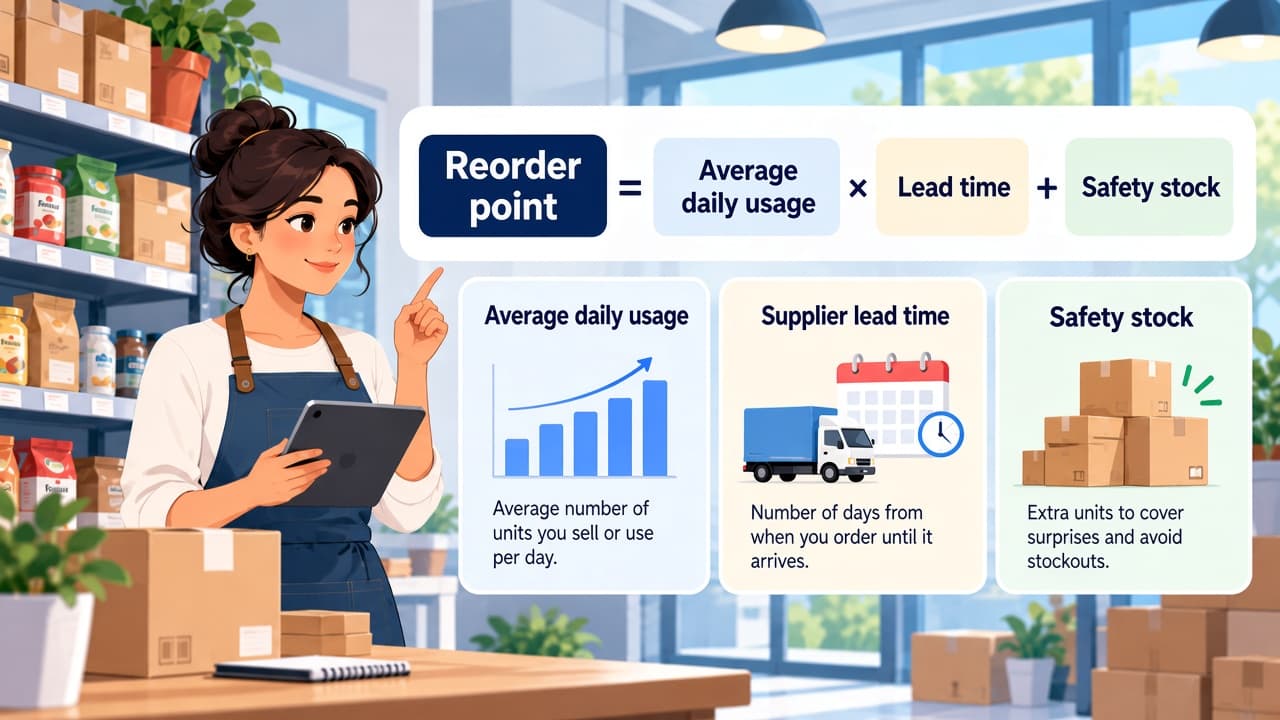
You need three figures: how much you sell, how long the supplier actually takes, and how much extra you want to keep.
How much you sell per day
If 120 units left the shelf in the last 30 days, average usage is
120 ÷ 30 = 4 units a day.
Not every product behaves the same way. Some sell every day and others sell in bursts. Promotions, weekends, Christmas, back to school and holidays move the number. Use sales history as the reference and recalculate when the pace changes.
How long the supplier takes
If you order on Monday and you usually receive it on Friday, count 4 or 5 days.
The figure that matters is not the one the supplier promises. It is the one they take. If they say 3 days and deliveries almost always arrive in 5 to 7, planning on 3 leaves you without the product. A history of purchases and receipts shows who delivers on time and who runs late.
What safety stock is
It is an extra quantity for two cases: demand jumping, or the order arriving late.
If you normally sell 4 a day and one week you move to 7, or you expected the order in 5 days and it arrives in 8, you hit zero without that reserve. It is also not an excuse to fill the storeroom. Surplus has a cost too. The aim is the balance, not the maximum.
A worked example
A pharmacy sells about 6 units a day of a medicine. The supplier takes 4 days, and the pharmacy keeps 12 as safety stock.
6 × 4 = 24
24 + 12 = 36
The reorder point is 36 units. Near that figure, it is time to build the next order.
Do not use the same minimum for everything
Each product sells differently, takes a different time to arrive, and weighs differently in your sales. One may be hard to get and seasonal. Another sells once every few weeks. The same minimum for both makes little sense. The ones you sell most, or the ones that hurt most when they are missing, deserve their own calculation.
How many days of stock you have left
Days of stock = current stock ÷ average daily sales
With 40 units and daily sales of 5, 40 ÷ 5 = 8 days. For the person running the
business, "8 days" says more than "40 units". If the supplier takes 7, that
product needs a look now.
Do not forget what is already on the way
You can have 20 units on hand, a reorder point of 30, and 50 units arriving tomorrow. Looking only at the shelf, the conclusion is to buy. You already did.
A sensible restock looks at stock on hand, purchase orders not yet received, reserved units and transfers between locations. Otherwise the same product gets ordered twice.
How much to buy
The reorder point says when. The quantity comes from a target stock level.
If the target is 100, 25 are on hand and 15 are on the way, expected stock is 40. To get back to 100 you need about 60 units. Then the supplier's conditions come in: a minimum order, full cases, a volume discount, and whether they have it.
When there is not enough cash to restock everything
The calculation may call for Q15,000 and the till has Q6,000. Then you prioritise.
High. What accounts for a lot of sales, turns over quickly, and customers expect to find every time.
Medium. Frequent sales, but it can wait a few days.
Low. Slow turnover, or you already have enough.
The cash goes where a stockout hurts most. Starting with 20 or 30 important products pays off more than configuring the whole catalogue on day one.
Mistakes that repeat
The same minimum for the whole catalogue. Sales and suppliers are not the same.
Buying only when almost nothing is left. If the supplier takes several days, that moment is already late.
Trusting memory. It works with few products. With a larger catalogue, more locations and more suppliers, it stops working.
Not recording stock in and stock out. If what is written down does not match the shelf, any formula comes out wrong.
Ignoring purchases already on order. You end up ordering the same product twice.
Keeping extra just in case. That stock is cash standing still.
From buying by memory to buying with data
"I think we are running low." "Order another two cases." "We sold a lot last week." That is enough when the catalogue is small. After that, the useful question stops being what we think is missing, and becomes which products need restocking given stock, sales and the supplier's real lead time.
On inventory control you set a minimum per product. When stock drops below that point, the system alerts you. You work out the number yourself, with the formula above. What the record prevents is discovering the gap only when a customer has already asked.
Start with ten products
You do not need the whole catalogue this week.
- Pick the 10 products that matter most.
- Check how much left the shelf in the last 30 days.
- Work out sales per day.
- Write down how long the supplier actually takes, not what they promise.
- Set a small safety stock.
- Calculate the reorder point.
- Look at it again in a few weeks.
The aim is not a perfect calculation. It is to stop buying only when it is already an emergency. Well-run stock is not having more product. It is having the right product, in the right quantity, at the right time.